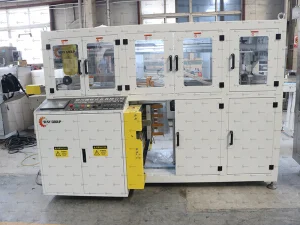
In today’s highly competitive manufacturing industry, speed, consistency, and labor efficiency are no longer optional — they are essential. That’s exactly why more factories are investing in a Middle Bag Packaging Machine for fully automatic bag-in-bag packaging solutions.
Whether you produce wet wipes, tissues, food products, medical supplies, or daily necessities, packaging efficiency directly affects your production costs and customer satisfaction. Traditional manual bagging methods are slow, labor-intensive, and prone to errors. In contrast, automatic middle bag packaging systems dramatically improve output while reducing operational headaches.
So, what makes this machine such a game changer?
Here are the 7 powerful benefits that are driving manufacturers worldwide to upgrade their packaging lines.
1. Significantly Improves Packaging Speed
One of the biggest advantages of a Middle Bag Packaging Machine is its ability to automate the entire bag-in-bag process.
Instead of relying on workers to manually place inner bags into larger middle bags, the machine performs:
- Automatic bag feeding
- Product counting
- Bag insertion
- Sealing
- Output conveying
As a result, manufacturers can achieve much higher production speeds with stable performance.
For high-volume factories, this means:
- Faster order fulfillment
- Reduced production bottlenecks
- Increased daily output
Many automated systems can run continuously for long hours with minimal downtime, making them ideal for mass production environments.
2. Reduces Labor Costs Dramatically
Labor shortages and rising wages are becoming major challenges worldwide. Manual bagging operations often require multiple operators per line.
A modern automatic bag-in-bag packaging machine can replace several manual workers while maintaining higher consistency.
This creates immediate benefits:
- Lower labor dependency
- Reduced training costs
- Fewer human errors
- Better workforce allocation
For many factories, the machine pays for itself through labor savings within a relatively short period.
3. Enhances Packaging Consistency and Product Quality
Customers expect clean, professional, and uniform packaging. Manual packaging can lead to:
- Misaligned bags
- Inconsistent sealing
- Wrinkled packaging
- Product contamination
Automatic middle bag packaging machines solve these problems through precise servo control systems and stable automation technology.
The result is:
- Cleaner packaging appearance
- Better sealing quality
- Improved brand image
- Higher customer trust
Consistent packaging also helps products stand out on retail shelves and improves export competitiveness.
4. Supports Multiple Product Types
Another powerful advantage is flexibility.
Today’s advanced middle bag packaging systems can handle a wide range of products, including:
- Wet wipes
- Facial tissues
- Cotton products
- Disposable hygiene products
- Snacks
- Medical supplies
- Household products
Many machines also support different bag sizes and packaging formats with quick adjustment features.
This flexibility helps manufacturers respond faster to market changes without purchasing multiple packaging lines.
5. Improves Hygiene and Safety Standards
For industries such as food, medical, and hygiene products, packaging cleanliness is critical.
Manual handling increases the risk of:
- Product contamination
- Foreign particles
- Packaging damage
Automatic packaging systems reduce direct human contact during production, helping manufacturers maintain stricter hygiene standards.
This is especially important for:
- Wet wipes manufacturers
- Baby product factories
- Medical consumable suppliers
- Food packaging companies
A cleaner packaging process also improves compliance with international quality standards.
6. Minimizes Material Waste
Packaging material costs continue to rise every year. Even small amounts of waste can create major losses over time.
A high-quality middle bag packaging machine uses accurate positioning and intelligent control systems to reduce:
- Bag misalignment
- Sealing failures
- Empty packaging
- Film waste
Better material utilization means:
- Lower packaging costs
- Higher production efficiency
- Improved sustainability
For companies focused on lean manufacturing, this benefit is extremely valuable.
7. Helps Factories Move Toward Smart Manufacturing
Industry 4.0 and smart factories are no longer future concepts — they are happening now.
Automatic bag-in-bag packaging machines can integrate with:
- Conveying systems
- Robotic palletizers
- Cartoning machines
- MES production systems
- Data monitoring platforms
This allows manufacturers to build a fully automated packaging line with real-time production monitoring and higher operational efficiency.
Factories that adopt automation earlier often gain stronger long-term competitive advantages.
Frequently Asked Questions About Middle Bag Packaging Machines
What is a middle bag packaging machine?
A middle bag packaging machine is an automated system designed to place smaller packaged products into larger middle bags for secondary packaging purposes.
Which industries use bag-in-bag packaging machines?
These machines are widely used in:
- Wet wipes production
- Tissue manufacturing
- Food packaging
- Medical product packaging
- Daily chemical industries
Can one machine handle different bag sizes?
Yes. Most modern machines support multiple bag sizes and product formats with adjustable settings.
Is automatic bag-in-bag packaging suitable for small factories?
Absolutely. Even medium-sized factories can benefit from reduced labor costs, improved efficiency, and better packaging consistency.
Conclusion
As manufacturing competition becomes more intense, automation is quickly becoming the key to profitability and long-term growth.
A Middle Bag Packaging Machine is more than just packaging equipment — it is a strategic investment that helps factories:
- Increase production speed
- Reduce labor costs
- Improve packaging quality
- Maintain hygiene standards
- Reduce material waste
- Prepare for smart manufacturing
For companies looking to scale production while maintaining high efficiency and professional packaging quality, automatic bag-in-bag packaging technology is rapidly becoming an industry standard.