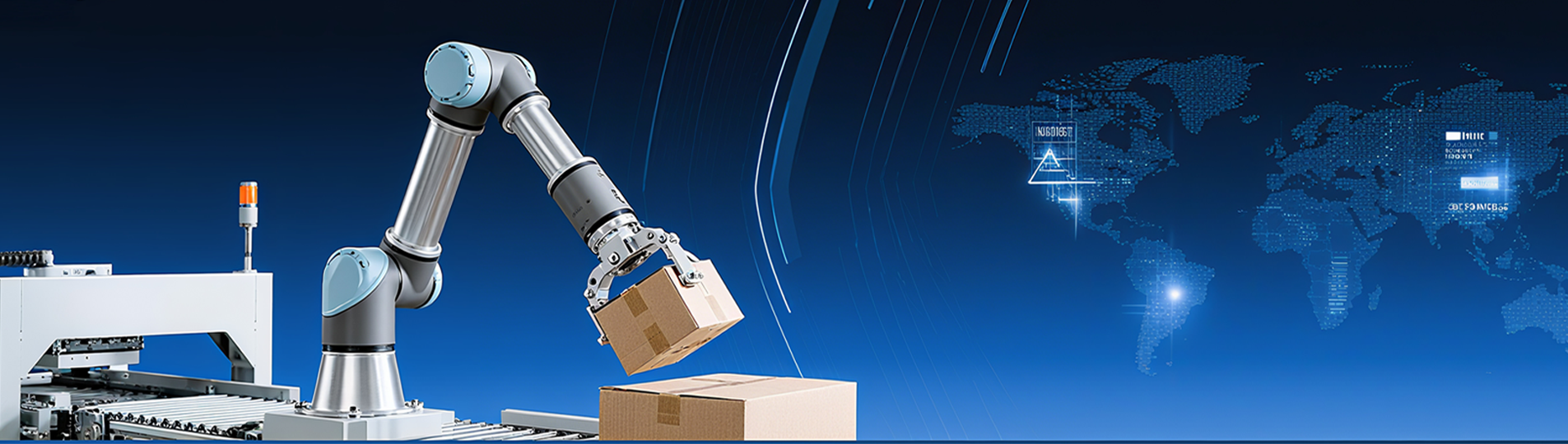
Picture this: your production line is running smoothly, products are flowing fast, but everything slows down the moment packing and palletizing begin. Bottlenecks form, labor costs spike, and mistakes creep in. Sound familiar?
Now imagine a fully synchronized system where products move seamlessly from manufacturing to packing to palletizing—without manual handling or delays. That’s the power of integrating automated packing and palletizing lines with your production line.
So, can automated packing and palletizing lines really be integrated with production lines?
Short answer: Yes—and it’s one of the smartest moves modern factories can make.
1. What Does “Integration” Actually Mean?
Integration means connecting your production equipment (fillers, formers, or assembly machines) directly to automated case packers and palletizers using conveyors, sensors, and control systems.
Instead of:
Production → buffer → workers → packing → workers → palletizing
You get:
Production → automated packing → automated palletizing → warehouse
This creates a continuous, intelligent flow of products with minimal human intervention.
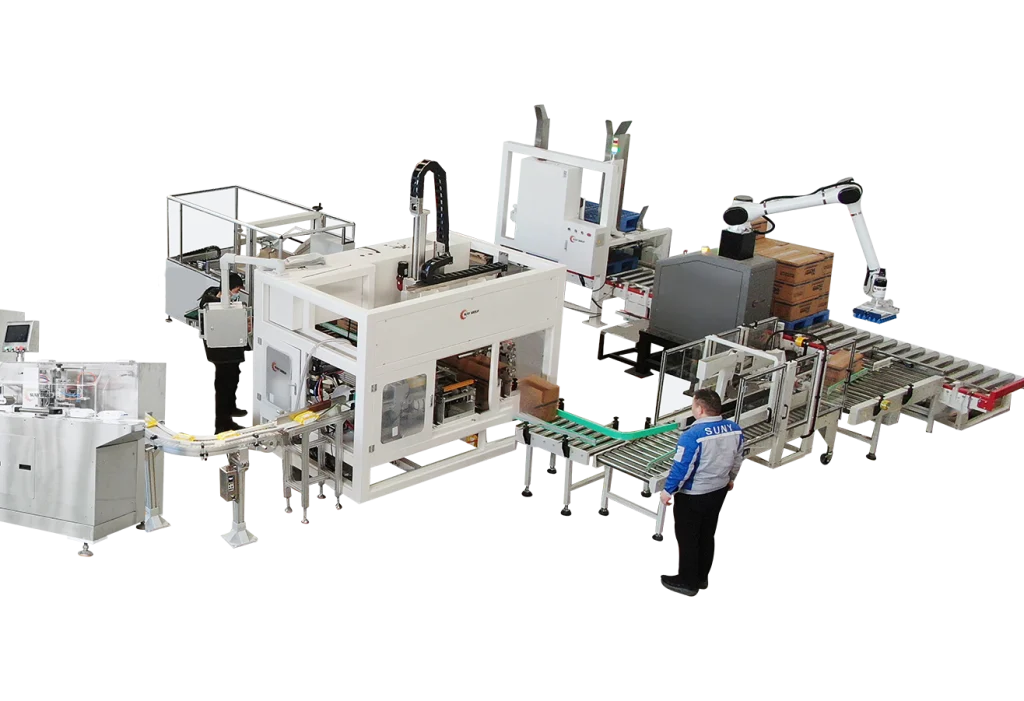
Can automated packing and palletizing lines be integrated with production lines
2. Can Automated Packing and Palletizing Lines Be Integrated with Any Production Line?
In most cases, yes. Integration is possible for:
- Food and beverage lines
- Pharmaceutical and medical product lines
- Household and personal care products
- E-commerce and logistics operations
- Industrial and hardware manufacturing
Thanks to modular machine design and programmable logic controllers (PLCs), systems can be tailored to match line speed, product size, and packaging style.
Key Insight:
Over 60% of manufacturers worldwide are investing in production-line automation, driven by labor shortages and rising costs. Integration is no longer a luxury—it’s a necessity.
3. Frequently Asked Questions (FAQs)
❓ Will integration slow down my production line?
No. In fact, it usually increases output. Automated palletizers can handle up to 40–60 cases per minute, far outperforming manual labor.
❓ Is integration complicated?
It can be complex—but with proper planning, it becomes manageable. Key factors include:
- Line speed synchronization
- Product orientation
- Case and pallet layout logic
- Safety fencing and emergency stops
A professional system integrator makes this process smooth and predictable.
❓ What about product changes and flexibility?
Modern systems support:
- Quick changeovers
- Recipe-based control
- Adjustable grippers and guides
This means you can switch SKUs without tearing down the whole line.
4. Why Integration Delivers Massive Business Benefits
Let’s talk results.
- Labor Savings
Automated palletizing reduces reliance on manual stacking, which is both expensive and injury-prone. Many plants report 30–50% labor cost reduction after integration.
- Higher Efficiency
Integrated lines eliminate waiting time between processes. This can boost overall equipment effectiveness (OEE) by 10–25%.
- Consistent Quality
Robots stack with millimeter accuracy. No crushed cartons. No unstable pallets. Just clean, uniform loads ready for shipping.
- Better Safety
Manual palletizing is one of the leading causes of workplace injuries. Automation dramatically reduces lifting-related accidents.
So, can automated packing and palletizing lines be integrated with production lines?
Absolutely—and when done right, they transform operations from fragmented to fluid. Integration increases speed, reduces costs, improves safety, and unlocks future scalability.
If your production line is already automated but your packing and palletizing aren’t, you’re leaving money, time, and efficiency on the table.
Integration isn’t just an upgrade.
It’s a competitive advantage.